exegesis & eisegesis
 Exegesis and eisegesis are two words that come up fairly regularly in conversations about scriptural interpretation. The general view is that of the two, exegesis is preferred, and eisegesis is best avoided. What are these two concepts? How do they differ? Does this distinction have any bearing on how we should be reading our Bibles?
Both concepts share a Greek root—the word ἄγω (ago), which means “to lead.” While these words share the same root, their prefixes have opposite meanings—ἐκ (ek) means “from” or “out of,” while εἰς (eis) means “into.” Exegesis, then, means “leading something from or out of,” while eisegesis means “leading something into.”
How does this distinction affect how we read the Bible? When reading a text, there are two ways to approach assigning meaning. Both have valid uses. Eisegesis occurs when we start with an assumption about what a particular passage says, and then look in the text to see how it has that meaning. We are in a sense leading the meaning we have in our minds into the text. This approach can be useful when exploring dogma (already definitively established interpretations by the Church) or when trying to follow the interpretation and perspective of another. Exegesis occurs when we view the text as primary and try to lead the meaning from the text in a way that is separate from any preconceived notion about what the text means.
In the Turning to God’s Word approach to Bible study, we strongly encourage the practice of exegesis. Learning to approach the text with an unbiased perspective is the first step in learning to encounter it fresh with every reading. This is essential to coming to understand the Scripture as the living word of God.
Which of these two words better describes your approach to Bible study? Why do you prefer that method? When might it be appropriate to try the other approach?
you also may like our free year-long study of Scripture & the Rosary (digital only)
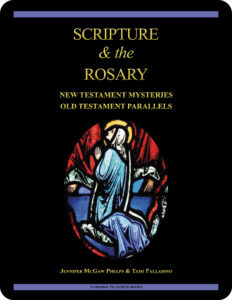 Scripture & the Rosary: New Testament Mysteries, Old Testament Parallels, a 26-lesson Catholic Bible study with an imprimatur, looks at the biblical foundations of the Rosary. The study includes lessons on Pope St. John Paul II’s Rosarium Virginis Mariae (Rosary of the Virgin Mary), the Apostles’ Creed, and the Luminous Mysteries as well as the original 15 Mysteries of the Rosary. Color photographs of stained glass windows depict key scenes in the lives of Jesus and Mary. In lieu of a sample, check out our free digital lessons.
 Click on the picture of the statue of Moses with horns (above) to learn more about Lost in Translation. A new entry is archived each Monday. Contact us to receive Lost in Translation by email every week. You may use any of the contact links on our website to ask Matthew a question.