faith
 In the Letter to the Galatians 3:26 (NABRE) Paul writes: “For through faith you are all children of God in Christ Jesus.” This idea is central to Christianity, and much has been made of it over the centuries. A clear understanding of the meaning of faith as a theological virtue is crucial to understanding this passage.
The Greek word πίστις (pistis) is the word that in the New Testament is translated as “faith,” and it also can be translated as “trust” or “belief.” Confusion arises in how we perceive this concept due to the significant disparity between the English meaning and usage of the words trust and belief.
We typically talk about believing in something as an idea. “I believe in God.””I believe in freedom.” “I believe in truth, justice, and the American way.” The idea of belief focuses on what is being accepted. Trust as a concept, by contrast, focuses not on what piece of information we are accepting but on the person we are trusting. I trust my parents, my employer, my government, or my church. When we trust, we accept a person or an entity, and the concepts or ideas that we accept are secondary.
Faith as a concept originally meant the idea of trust rather than the idea of belief. Having faith in Jesus or in God means accepting God and all that he offers. Significant confusion results when we mistakenly presume that faith instead refers only to belief and that all God asks of us is to believe that he is or that he is God. To realize the promise in Paul’s statement that “through faith [we] are all children of God,” we are required to do more than accept God intellectually. We’re asked instead to surrender to God in trust. This passage should prompt all of us to ask ourselves whether we truly trust Jesus.
The Litany of Trust is a related prayer written by the Sisters of Life (www.sistersoflife.org) asking Jesus for deliverance from the things that hold us bound, and placing our trust in Jesus’ promises.
related topics: belief; believe in Jesus; faith (2); justification; little faith
you also may like our free year-long study of Scripture & the Rosary (digital only)
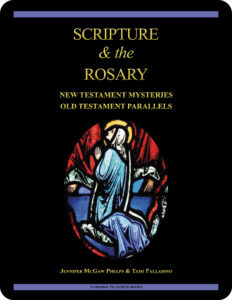 Scripture & the Rosary: New Testament Mysteries, Old Testament Parallels, a 26-lesson Catholic Bible study with an imprimatur, looks at the biblical foundations of the Rosary. The study includes lessons on Pope St. John Paul II’s Rosarium Virginis Mariae (Rosary of the Virgin Mary), the Apostles’ Creed, and the Luminous Mysteries as well as the original 15 Mysteries of the Rosary. Color photographs of stained glass windows depict key scenes in the lives of Jesus and Mary. In lieu of a sample, check out our free digital lessons.
 Click on the picture of the statue of Moses with horns (above) to learn more about Lost in Translation. A new entry is archived each Monday. Contact us to receive Lost in Translation by email every week. You may use any of the contact links on our website to ask Matthew a question.