
Israel & Judah
 The difference between Israel and Judah confuses many people when they read the Old Testament. The Book of Jeremiah 23:5–8 (NABRE) calls attention to a linguistic peculiarity in the Scriptures. The word Israel in the Old and New Testaments can have at least four distinct meanings depending on context. How many can you list before reading on?
Israel first appears in the book of Genesis 32:29 (NABRE) when God renames Jacob. The name Israel loosely means something like “he who wrestles with God.” The exact etymology of the Hebrew is uncertain. For our purposes, the first meaning of Israel in the Old Testament and the one used in the book of Genesis is the name of the patriarch, a person.
The second meaning of Israel comes about at the start of the book of Exodus, which begins to refer to all the descendants of the patriarch as the children of Israel. By the time the people reach the base of Mount Sinai in the nineteenth chapter of the book of Exodus, they’re instead referred to as the people of Israel, who are divided into 12 tribes based on the 12 sons of Jacob. Israel in this context refers to a racial or ethnic group.
Beginning with the anointing of Saul as king of Israel in the First Book of Samuel 11:15 (NABRE), the name Israel is used to refer to a political entity, the kingdom that consists of the people of Israel. At that time, it represented all 12 tribes and will continue to do so throughout the period of the united kingdom under David and Solomon.
Beginning in the second chapter of the Second Book of Samuel (NABRE) when David is anointed king of Judah before ultimately also being anointed king of Israel in the fifth chapter, we see the emergence of a distinction between Judah and the remaining tribes. Following the split of the united kingdom at the death of Solomon, the northern kingdom, consisting of 10 tribes, is called Israel, and the southern kingdom, consisting of the tribes of Judah and Benjamin, is called Judah. (The words Jew and Judaism are derived from the name Judah, but descendants of Judah are called Judahites.) Most later biblical literature uses Israel to refer to either the patriarch or the northern kingdom.
When we see the use of the words Israel and Judah in the Scriptures, it’s important to take a moment to ask ourselves which of the possible meanings are intended in order to make sure that we clearly understand the intent of the passage we’re reading. How many of these meanings of Israel can you find in this week’s reading from the Book of Jeremiah 23:5–8 (NABRE)?
you also may like our free year-long study of Scripture & the Rosary (digital only)
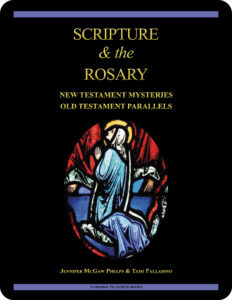 Scripture & the Rosary: New Testament Mysteries, Old Testament Parallels, a 26-lesson Catholic Bible study with an imprimatur, looks at the biblical foundations of the Rosary. The study includes lessons on Pope St. John Paul II’s Rosarium Virginis Mariae (Rosary of the Virgin Mary), the Apostles’ Creed, and the Luminous Mysteries as well as the original 15 Mysteries of the Rosary. Color photographs of stained glass windows depict key scenes in the lives of Jesus and Mary. In lieu of a sample, check out our free digital lessons.
 Click on the picture of the statue of Moses with horns (above) to learn more about Lost in Translation. A new entry is archived each Monday. Contact us to receive Lost in Translation by email every week. You may use any of the contact links on our website to ask Matthew a question.